
Stop Studying Publishing and Start Publishing
How choosing one simple path accelerates your growth as a writer

One of the biggest mistakes new writers make is believing they need to understand everything before they publish anything.
They think they need to master every platform. They think they need the perfect system. They think they need more research, more planning, more certainty.
What they really need is one simple path and the courage to take the first step.
You don’t need to master the internet to become a published writer. You need to publish something, learn from it, and improve as you go.
Complexity Is the Enemy of Momentum
When you’re starting out, complexity feels productive. It feels responsible. It feels like preparation.
In reality, it often becomes a form of procrastination.
You can spend months comparing platforms, reading tutorials, watching videos, and mapping out strategies—and still never ship a single piece of work. Meanwhile, someone else publishes a short, imperfect book, learns from it, and moves forward.
Progress favors the simple.
The goal at the beginning is not optimization it is movement.
Pick One Primary Publishing Path
Instead of trying to do everything, choose one primary publishing path and commit to learning it well.
That path might be:
Publishing short books
Writing weekly essays
Sharing practical guides
Building a small catalog of useful work
Many authors begin with Amazon KDP because it removes a lot of technical friction. You don’t need to build a website, manage inventory, or understand complex marketing funnels. You upload a manuscript, create a cover, write a description, and press publish.
That simplicity matters.
Not because it’s perfect—but because it allows you to learn fast.
Your First Publication Is a Classroom
Your first published piece will teach you more than months of research ever could.
It will teach you:
How long things actually take
Where you get stuck
What parts feel easier than expected
What parts feel harder
What readers respond to
What you’d do differently next time
No amount of theory can replace that feedback loop.
You can read about publishing all day long, but until you upload something real and let strangers interact with it, you’re guessing.
Publishing turns assumptions into data.
Research Has Diminishing Returns
Research is useful—up to a point.
After that point, it becomes noise.
The problem is that beginners rarely know where that point is, so they default to more. More articles. More advice. More opinions.
But every platform, genre, and audience behaves slightly differently. What worked for one author five years ago may not work for you today.
The fastest way to clarity is not another guide.
It’s a small experiment.
Publish something short. Observe what happens. Adjust.
Speed Creates Confidence
Confidence does not come from knowing everything. It comes from doing something, surviving it, and realizing you can do it again.
When you publish simply:
You reduce emotional risk
You lower the bar for completion
You increase your output
You build trust in yourself
Each finished project makes the next one easier.
Momentum compounds.
Start With Something Manageable
Your first publication does not need to be big.
In fact, it shouldn’t be.
A short book, a practical guide, or a focused essay is often the best place to begin. Smaller projects:
Finish faster
Teach faster
Fail cheaper
Improve quicker
The goal is not to create your life’s work on day one.
The goal is to create your first completed work.
Feedback Is a Gift You Can’t Think Your Way Into
Until your work is public, all feedback lives in your head. Once you publish, feedback becomes real. Sometimes it shows up as:
Reviews
Sales (or lack of them)
Emails
Questions
Silence
All of it is information. Silence tells you something. Engagement tells you something. Confusion tells you something. You don’t need thousands of readers to learn.
You just need enough exposure to see patterns.
Learning Happens After Shipping
Here’s the part most people miss:
The real learning begins after you publish.
Before publishing, everything is hypothetical. After publishing, everything is concrete. You start noticing:
Which topics attract attention
Which titles feel clear
Which descriptions convert
Which ideas resonate
Which ones fall flat
That insight doesn’t come from planning. It comes from participation.
Once you publish, then you learn something.
You Can Always Improve the Next Version
Perfectionism assumes that mistakes are permanent.
They’re not.
You can:
Update your content
Rewrite descriptions
Improve covers
Refine ideas
Publish better versions later
Publishing simply doesn’t lock you into failure. It gives you a starting point. Every professional writer you admire started with work they would now rewrite.
The difference is—they started.
Simple Publishing Builds Long-Term Skill
Each project teaches you transferable skills:
Writing clearer
Structuring ideas
Explaining concepts
Meeting deadlines
Finishing what you start
These skills matter more than platform hacks. Platforms change. Skill compounds. If you can consistently publish clear, useful work, you’ll be able to adapt anywhere.
The Only Way Forward Is Through
If you’re waiting until you feel ready, you’ll be waiting a long time.
Readiness is not a prerequisite. Action is.
Pick one path. Keep it simple. Publish something small. Learn from it. Do it again.
Your first publication won’t be perfect—but it will be productive. And productivity beats perfection every time.
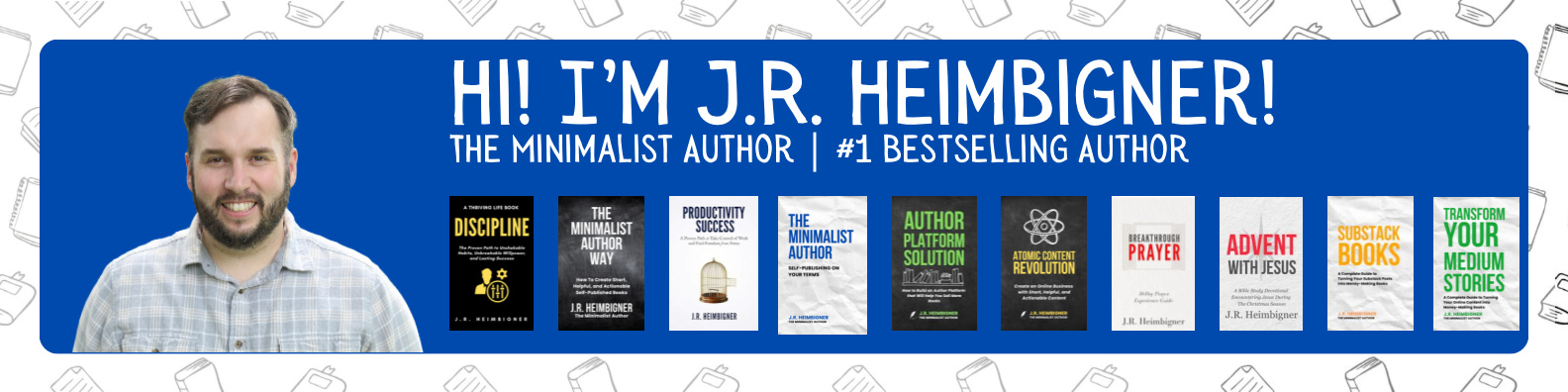
Hi! I’m J.R. Heimbigner!
I’m a #1 bestseller on Amazon and I have written & published 21 books (bookstore). And I just published my first fiction book under a pen name and it became a #1 bestseller with over 50 reviews in 30 days!
If you want more writing, publishing, and digital-product strategies, subscribe to my Substack where I teach authors how to build real online income.
And if you’re ready to publish your own mini book fast — the same system I use to grow my business — check out the Mini Book Accelerator Bundle. Or start with my 7-Day Mini Book Challenge 2.0!